

































Geoffs Narration
The GIST

While more study is needed, the connections appear to be piling up. If learning about them supports you, please support us 🙂
Talk about things being in the wind. Just about the time David Goldstein was providing evidence at the IACFS/ME conference that norepinephrine production in the brain was being slammed in ME/CFS and that the sympathetic nervous system was wobbly and underperforming, a neuroscientist, Jolien Hendrix, and her compadres in Belgium were coming to the conclusion that the same thing was happening, not in the brain but in the body.
Two recent papers/presentations suggest the sympathetic nervous system may be reeling in both the brain and the body.
Hendrix and company came to this rather startling conclusion not by an experiment but by a literature search; i.e. a finding that was apparently there in plain sight. The first systematic review to explore “biological evidence of adrenergic dysfunction in patients with ME/CFS and FM” was eye-opening indeed. (With no less than five ME/CFS/long-COVID papers published in the last year and more papers on chronic pain, these Belgian researchers have been active.)
Their recent paper, “Adrenergic dysfunction in patients with myalgic encephalomyelitis/chronic fatigue syndrome and fibromyalgia: A systematic review and meta-analysis“, provides a nice underpinning for Goldstein and Aregawi’s conclusion.
Note that whenever you see “adrenergic”, think sympathetic nervous system. The word adrenergic refers to adrenaline – which is now usually referred to as epinephrine. (Adrenergic is derived from a Greek word which means “drive away”.)
The GIST
- Talk about things being in the wind. Just about the time David Goldstein was providing evidence at the IACFS/ME conference that norepinephrine production in the brain was being slammed in ME/CFS and that the sympathetic nervous system was wobbly and underperforming, a neuroscientist, Jolien Hendrix, and her compadres in Belgium were coming to the conclusion that the same thing was happening not in the brain but in the body.
- The consensus view has been that the sympathetic nervous system (SNS), or “fight or flight” system, has been turned on and that the parasympathetic nervous system (PNS), or “rest and digest” system, has been turned down in ME/CFS. That makes sense given the “wired but tired” symptom which seems to signal that fight/flight is in full swing while the “rest and digest” system which helps us to rejuvenate is largely absent.
- When these researchers looked at what happened to the sympathetic nervous system during/after exercise, though, they found a different story. In healthy people, the sympathetic nervous system kicks in to speed blood and nutrients to the muscles. In people with ME/CFS, though, instead of engaging, it’s actually being inhibited.
- Why would the SNS turn itself down just when it’s really needed? Probably to protect itself. It turns out that the fight/flight is indeed in overdrive but it’s in overdrive all the time. The authors conjectured that it’s already so depleted that, when it’s time to turn on its engines, it ramps down to avoid blowing a gasket (so to speak). We’ve seen this pattern time and time again when it comes to exertion studies.
- This appears to fit very well with Bob Naviaux’s idea that the bodies of ME/CFS patients are in a “cell danger response” and are kind of hunkered down and trying to avoid any damage.
- The Goldstein/Aregawi’s low brain NE levels that we recently discussed appear to fit these findings really well. Because the main producer of NE in the brain – the locus coeruleus – has strong connections to sympathetic nervous system neurons, reduced production in the brain could translate into a compensatory effort in the body to boost sympathetic nervous system activity.
- Over time, that chronic activation could burn out the SNS in the body as well. In the end, we have two fight/flight systems – one in the brain and one in the body – that have both become depleted and exhausted.
- Because the sympathetic nervous system coordinates the exercise response, it’s possible that this strange depletion would translate to the many failures on the molecular level to respond either at all, or properly, to exercise that the Hanson group has found.
- Lots of connections appear to be lining up, but we must be careful: these are early studies and their findings need to replicated and explored further. Still, it was very good to see two independent research groups within a couple of weeks coming to much the same conclusion regarding the sympathetic nervous system – one in the brain and one in the body.
Donation Drive Update

The connections seem to be adding up!
Thanks to everyone who have brought us almost 30% of the way to our goal!
I love seeing possible connections show up, and this blog is full of them. The amazing thing is that these new connections have almost emerged overnight. First, there was the low norepinephrine in the brain finding, which could relate to the damaged hypothalamus found in the autopsy study and the sympathetic nervous system inhibition recently found in the body.
That’s all within the last 3 weeks (!). That’s what can happen, though, when you stay on top of these fast-moving fields – and that’s our commitment. If that supports you, please support us!
HEALTH RISING IS NOT A 501 (c) 3 NON-PROFIT
The Brain and the Body?
The authors got right to the point by reporting that prior reviews had “consistently highlighted sympathetic dominance in ME/CFS, evidenced by elevated heart rate and reduced heart rate variability”. The new review uncovered more evidence of sympathetic nervous system dominance (increased levels of adrenaline (norepinephrine) and increase B1AR expression at baseline).
Indeed, the consensus view has been that the sympathetic nervous system (SNS), or “fight or flight” system, has been turned on and that the parasympathetic nervous system (PNS), or “rest and digest” system, has been turned down in ME/CFS. Because the PNS regulates the SNS, the idea has been to try to plump up the PNS in order to calm the SNS and let the body rest and rejuvenate.

An increase in inhibitory factors after exercise suggests that the sympathetic nervous system may be shutting itself down in order to protect itself.
Something changed, though, when these researchers looked at what happened after exercise. ME/CFS patients posted a greater rise in a variety of adrenergic receptors (α₂A AR, β2 AR and COMT), and in the expression of the COMT gene, than healthy controls.
(Through their interaction with the outside environment, the receptors on a cell determine what the cell does; i.e., the activation of a receptor triggers the cell to do something. The cell makes certain actions more likely by increasing the number of receptors on its outside. The increased levels of these adrenergic receptors after exercise increases the likelihood of the sympathetic nervous system activity. The question is, what kind of activity?
In this case, the α₂A AR receptors inhibit the release of catecholamines (norepinephrine, epinephrine, and dopamine) and COMT actually catalzyes the degradation of catecholamines.
Exercise, then, appears to reduce levels of the neurotransmitters that run the sympathetic nervous system. The authors believe the cells in ME/CFS may be putting the brakes on the sympathetic nervous system (SNS) (at just the wrong time) because it was already over activated (e.g. the increased heart rate, reduced heart rate variability, increased adrenaline (epinephrine) and B1AR expression at baseline) prior to exercise.
Note that in healthy people, the opposite occurs: exercise triggers a temporary increase in catecholamines and sympathetic nervous system activity in order to drive oxygen and nutrients to the muscles.
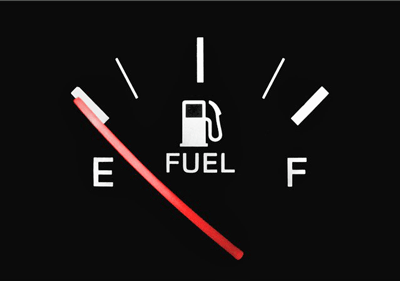
Hendrix’s paper suggests a common theme – a near empty tank that has little or nothing left to give.
If these researchers are right, at the same time that healthy people are ramping up their SNS in order to be able to exercise, people with ME/CFS are shutting it down. It’s no surprise that people with ME/CFS have trouble exercising.
In fact, the SNS seems at odds with itself. At the same time it’s ramping down, it’s also increasing, possibly in a compensatory manner, B2 AR expression in order to squeeze as much use out of the catecholamines that are present.
The findings suggest that ME/CFS may be a high-drive, low-capacity norepinephrine system; i.e. the gas pedal in the SNS is pushed to the floor but the engine quickly poops out – something we’ve seen time and time again in exertion studies.
Hypothesis
At this point, this is a hypothesis, and the authors acknowledge that more work needs to be done to properly test it; they produce a mechanistic pathway designed to do that, which includes catecholamine metabolites, enzymes involved in catecholamine synthesis, and genetic/epigenetic factors.
They believe that the hyperadrenergic-POTS-leaning subgroup may be experiencing massive increases in NE, at times, and perhaps more compensatory upregulation of the inhibitory factors (α₂A/COMT). That group would have to be teased out in studies.
Incorporating the Brain Findings
Hendrix et al. clearly weren’t aware of the as-yet-unpublished Goldstein/Aregawi finding, which suggested that low norepinephrine brain production is present. That group came to this conclusion by measuring metabolites – one of the missing factors cited by Hendrix et al.
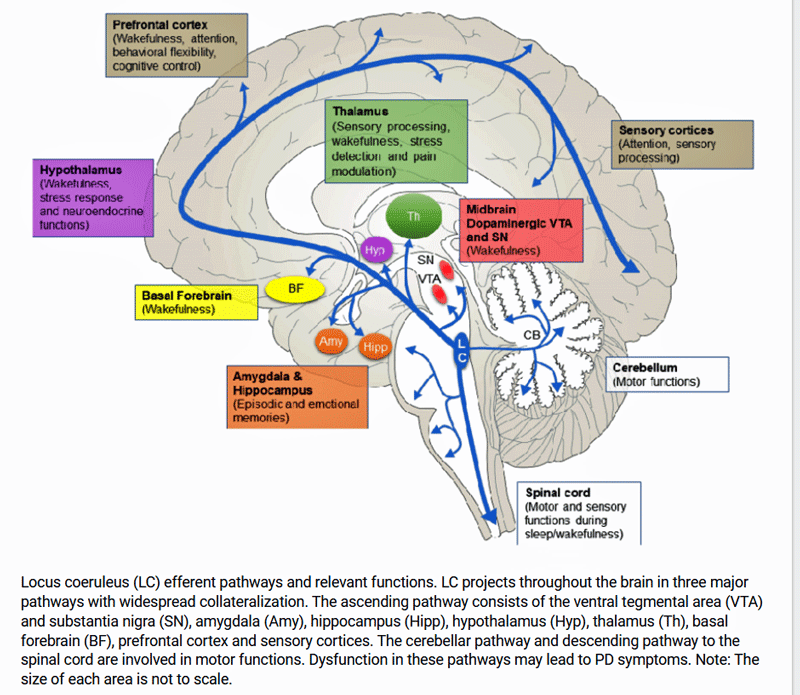
Check out how many areas of the brain, including the hypothalamus, that the locus coeruleus reaches. (Image Creative Commons: From-Locus-coeruleus-norepinephrine-Basic-functions-insights-Parkinsons-disease,-Bari-et-al-2020.-Neural_Regen_Res)
Goldstein/Aregawi’s low brain NE levels potentially match onto Hendrix et al.’s findings quite well. The main producer of NE in the brain – the locus coeruleus – has strong connections to sympathetic nervous system neurons and the hypothalamus and brainstem. (Note that the recent (unpublished) autopsy findings also implicated the hypothalamus.)
ME/CFS Autopsy Study Finds a Wrecked HPA Axis: The 2025 IACFS/ME Conference Report #3
The “dirty signals” coming from the locus coeruleus produce mischief in the autonomic nervous system, activating it in maybe the worst possible way: not knowing which way to go, the system remains in a state of constant vigilance. Pain, fatigue, and orthostatic intolerance result.
Role Reversal: Could a WEAKENED Fight/Flight Response Be Causing ME/CFS and Long COVID? The 2025 IACFS/ME Conference Pt. I
Ultimately, the same problem (an overstressed, wiped-out SNS) shows up in both sites. In this scenario, reduced brain NE production likely initiates the process. Over time, a chronically activated SNS system in the body decides that enough is enough and automatically shuts down during exercise in ME/CFS to prevent damage. Those systems that can respond to exercise tend to do so in a pathological way.
This seems to fit nicely with Naviaux’s idea that a “cell danger response” is keeping the body stuck in a kind of protective, hibernation-like state.
Note that the (unpublished) autopsy studies also suggest that overstressed, burnt-out hypothalamus and HPA axis may be present.
The “Failure to Respond” Findings
The findings from the Hanson group suggest that, at the molecular level, many systems (metabolites, proteomics, gene expression) either fail to respond (urinary metabolites, extracellular vesicles, gene expression) or respond pathologically (plasma metabolomics, proteomics) to exercise. It’s possible that the sympathetic nervous system’s failure to rise to the occasion and provide a coordinated response to exercise may come into play.
“A Failure to Respond”: the ME/CFS Extracellular Vesicle Exercise Study
The idea that fundamental systems such as the HPA axis (see autopsy blog) and the sympathetic nervous system are locked in a depleted but excited state is pretty compelling. We would expect, after all, that core systems need to have gone haywire to produce the kind of functional hit that occurs in these diseases.
All this needs to be tested. Hopefully, enough data has been reported that research groups will take this on. We need studies that incorporate all of this – the cerebrospinal fluid NE finding, brain imaging, adrenergic findings in the body, and multi-omics findings before and after exercise – to determine whether this scenario holds.
Time will tell. In the meantime, the connections seem to be mounting.
Donation Drive Update
The connections seem to be adding up!
Thanks to everyone who has brought us almost 30% of the way to our goal!
I love seeing possible connections show up, and this blog is full of them. The amazing thing is that these new connections have almost emerged overnight. First, there was the low norepinephrine in the brain finding, which could relate to the damaged hypothalamus found in the autopsy study and the sympathetic nervous system inhibition recently found in the body. Plus, it could also have something to do with the “failure to respond” molecular findings in ME/CFS.
That’s all within the last 3 weeks (!). That’s what can happen, though, when you stay on top of these fast-moving fields – and that’s our commitment. If that supports you, please support us!
HEALTH RISING IS NOT A 501 (c) 3 NON-PROFIT